Is Aston Martin Reliable? A Saudi Owner's Guide

Table of Contents
Is Aston Martin reliable? A current Aston Martin is a dependable car for its class, provided it is serviced to the official schedule. The DB12, Vantage S, DBX family and Vanquish are far more robust than the cars that built the brand's old reputation. In Saudi Arabia, heat and dust shorten the life of batteries, filters, tyres and fluids, so the car is serviced by time as well as by distance.
Ask whether Aston Martin is reliable and most of the answers online describe a different car. They describe a hand-finished V12 from twenty years ago, owned by someone in a mild climate who drove it at weekends.
The question a Saudi owner is asking is narrower and more useful. Will a current Aston Martin cope with 48 degrees in Riyadh in August, with fine dust on the Dammam highway, with a whole summer in a basement car park while the family travels? And what does it take to keep it that way?
The short answer is yes, with conditions. What follows is what has changed in the cars, what needs looking after, how each current model holds up, what the climate here actually does to a car, and what the authorised service route protects.
How reliable is a modern Aston Martin?
The answer depends on which Aston Martin you mean, and the dividing line sits roughly a decade back.
Earlier generations were built in small numbers with a high proportion of hand-assembled, low-volume components. Some of those parts belonged to one model and one era, which made them expensive and slow to source and made ownership more demanding than it is today.
The current range was engineered differently. Electrical architecture and engine management now come from proven, high-volume systems shared across the range, and the same 4.0-litre twin-turbo V8 sits in the DB12, the Vantage S and the DBX family. A component fitted to thousands of cars across several models has had its problems found and fixed long before it reaches yours.
The cars also report on themselves. Factory diagnostics read fault data directly, so a problem that once took a day to trace can be identified at the first visit. That is reliability as owners actually experience it: fewer return trips.
None of this makes an Aston Martin maintenance-free. It is a high-performance car built to tight tolerances, and it performs at its best when it is serviced on schedule. But the modern car is a dependable one, and the old reputation describes cars most buyers today will never own.
What to look after, by system
Every performance car has areas that need regular attention. These are the ones to know on an Aston Martin, with the context that matters.
• Electrical and battery. The area that most often needs attention, and in the Kingdom the most predictable. A modern Aston Martin draws a small current while parked to keep its security and connectivity systems alive. Leave one standing for several weeks in summer heat and the battery can be flat, and repeated deep discharge shortens its life. That is not a fault but a fact of ownership, with a simple fix covered below.
• Gearbox. The automated manual gearboxes on previous-generation cars wore their clutches quickly in stop-start traffic. Current cars use automatic gearboxes, with eight speeds in the DB12, Vantage S and Vanquish and nine in the DBX, and they are far better suited to city driving.
• Suspension and underbody. These are low cars. Car park ramps, speed bumps and kerbs account for more front splitter and underbody damage than any mechanical failure. Adaptive dampers are robust, but bushes and mounts work hard on poor surfaces.
On a current car bought new or through the authorised dealer, the list is short. On a pre-owned car of any age, almost every item above is covered by a pre-purchase inspection at the official service centre, and the DB12 buying guide: new vs pre-owned shows what that check looks like on a recent car.
Model-by-model reliability: DB12, Vantage S, DBX and Vanquish
The current range shares more than its styling suggests, and that shared engineering is the main reason it is dependable.
Aston Martin DB12
The Aston Martin DB12 arrived in 2023 as a grand tourer built around the twin-turbo V8 and an eight-speed automatic, with a new infotainment system developed in-house by Aston Martin. On a pre-owned example, a complete official service history is the best guide to how the car has been looked after.
Aston Martin Vantage S
The same V8 and the same eight-speed gearbox, in a smaller two-seat car. The Aston Martin Vantage S has a substantially uprated cooling system compared with the previous-generation Vantage, including a larger grille opening, additional radiators and a larger oil cooler. That matters more here than almost anywhere. Its main reliability consideration is physical rather than mechanical: low ground clearance and a firm rear end that does not enjoy poor surfaces.
Aston Martin DBX family
The DBX707 and the Aston Martin DBX S combine the twin-turbo V8 with a nine-speed wet-clutch automatic and all-wheel drive. Because it is an SUV that actually gets used, often as the family car, the DBX covers more distance than any other Aston Martin. That makes on-schedule servicing of brakes, tyres and fluids the deciding factor.
Aston Martin Vanquish
The Vanquish is the flagship, with a 5.2-litre twin-turbo V12. As the most powerful and most exclusive car in the range, built in lower volumes, it benefits from dedicated attention from the service team, with servicing tailored to each car and how it is used.
What is the most reliable Aston Martin?
Every current Aston Martin is dependable when serviced to the official schedule. The V8 models, the DB12, the Vantage S and the DBX family, share their engine and gearboxes across the range and have been in the field the longest, so parts and diagnostic experience run deepest. The V12 Vanquish, as the flagship, benefits from dedicated service attention. Within any model, the most reliable car is the one with a complete official service record.
Owning an Aston Martin in Saudi Arabia's climate
This is where general reliability advice stops being useful. Service schedules are written for a global average. A Saudi summer is not average, and three things take most of the strain.

Heat: batteries, coolant and air conditioning
Battery chemistry ages faster in heat. A battery that lasts five years in a temperate climate can be due much sooner here, and a car left for weeks while its owner travels for the summer comes back to a flat one. The fix is cheap: a battery maintainer connected whenever the car stands for more than a week or two, ideally in a shaded or covered space. The service team can recommend a suitable unit.
Coolant and engine oil work harder at sustained high ambient temperatures, especially on long highway runs at speed, and the air conditioning runs at full load for months at a time. This is why service intervals are set by time as well as distance: heat degrades fluids regardless of mileage.
Dust and sand: filters, paint and seals
Fine dust is the second load. Engine air filters and cabin filters clog faster here than the global schedule assumes, costing performance and air-conditioning efficiency before anyone notices. Windblown sand abrades paint and wears window and door seals, and UV hardens rubber and fades interior trim on cars parked in the open. Paint protection film, and a car cover for outdoor parking, are both worth considering.
Tyres and long highway runs
Tyre pressures rise with temperature, and a car set up in a cool basement at seven in the morning is a different car on the highway at two in the afternoon. Check pressures with the tyres cold, and more often than the handbook default. Performance tyres also age with heat as well as with distance, so the date code matters as much as the tread depth.
Long runs between cities at a steady speed are, if anything, easier on these cars than short urban trips. What tests them is heat soak while standing still.
A Saudi-tuned service rhythm
In practice, owners here are best served by:
• Servicing on time, not only on distance, even on low-mileage cars
• Asking for air and cabin filters to be checked at every visit, not only at scheduled replacement
• A pre-summer check in late spring covering battery health, coolant, air-conditioning performance and tyre condition
• A battery maintainer for any car left standing over the summer
• Shaded or covered parking wherever possible
Service, warranty and the authorised dealer
Reliability is not only a property of the car. It is also a property of who looks after it.
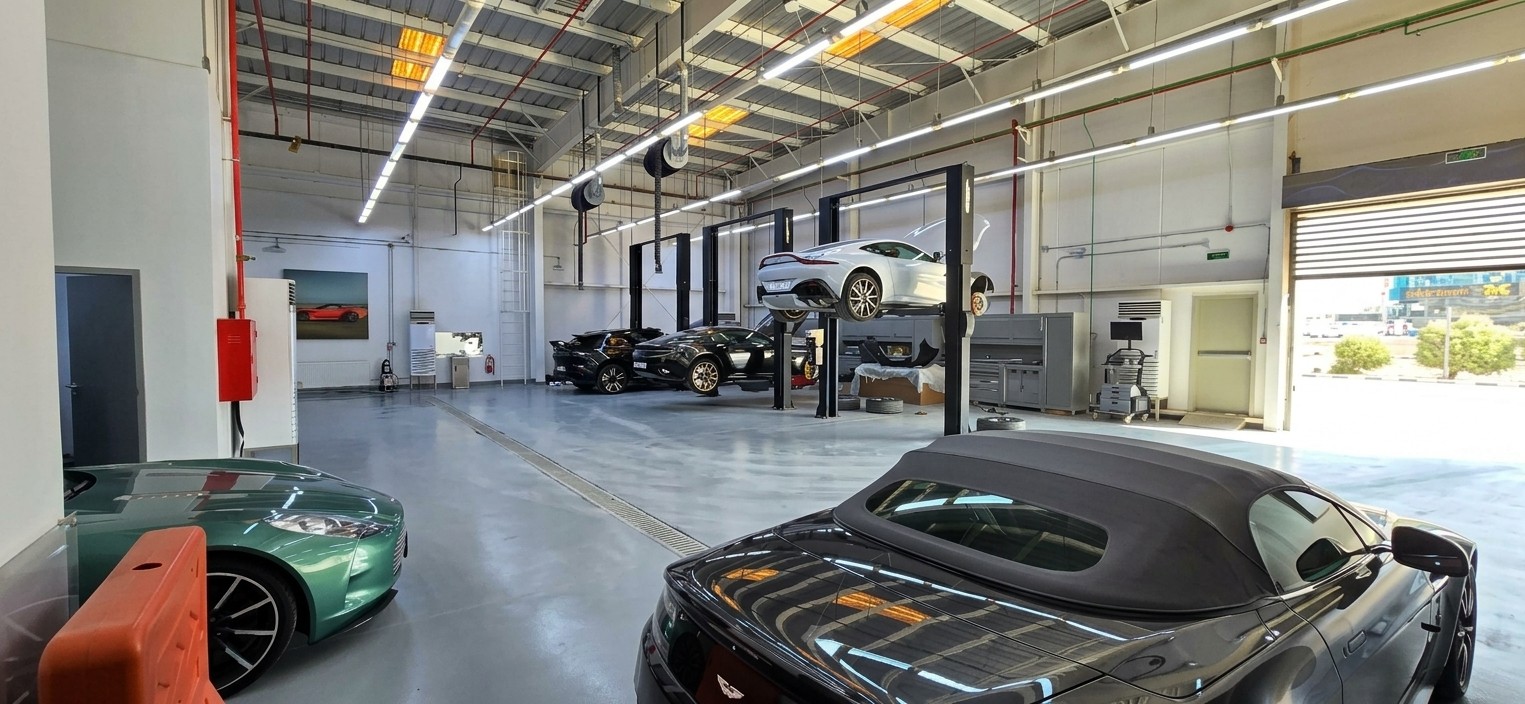
Scheduled servicing at the official Aston Martin service centre is carried out by Aston Martin-certified technicians using factory diagnostic equipment and the specialist tooling these cars were designed around. A general performance workshop can employ excellent people and still lack factory diagnostic access, which is a question of access rather than skill.
The new-car warranty in the Kingdom is published on the dealer's own listings as three years with unlimited mileage. Servicing to the official schedule is what keeps that warranty position intact, and using an independent workshop for scheduled work can affect it.
Genuine Aston Martin parts supplied through the dealer carry a 12-month parts warranty, and every visit is written into a digitally updated service record that stays with the car. Full detail sits on the Aston Martin service centre page.
What it costs to keep an Aston Martin reliable in Saudi Arabia
There is no single figure, because cost depends on model, specification and how the car is used. What can be said is where the money goes, and which items the climate moves.
• Scheduled servicing. The fixed cost, and the one that protects everything else
• Tyres. The largest running cost on most cars, and in heat they age by date as well as by wear
• Batteries. Replaced more often here than the global average suggests
• Brakes. Carbon ceramic brakes, where fitted, last considerably longer on the road than steel discs
• Filters and fluids. Replaced more often in dust and heat, at modest cost
For a figure on a specific car, the service team can quote against its model and history.
Does an Aston Martin hold its value?
Value retention follows the same logic as reliability. Current models, limited editions and desirable specifications hold up better than older cars, but the one factor an owner controls is history. A complete official service record, genuine parts and documented warranty work are what a buyer pays for at resale, and what they discount when it is missing. If you are weighing a change, value my Aston Martin is the place to start.
Aston Martin's official pre-owned programme, known as Timeless, is available in the Kingdom, with approved used cars inspected and sold through the authorised dealer. You can browse the Timeless cars currently available in Saudi Arabia on the Aston Martin pre-owned website, and ask the dealer about each car's service history and remaining warranty.
Next step: book a service consultation
If you already own an Aston Martin, a pre-summer check is the most useful single visit of the year. If you are considering one, the service team can tell you more about living with a specific model here than any review can. Book a service or test drive with the authorised dealer.
Is Aston Martin reliable? Frequently asked questions
Are Aston Martins reliable?
Yes, current Aston Martins are dependable for their class. The DB12, Vantage S, DBX family and Vanquish use proven, shared engineering and factory diagnostics, and they are far more robust than older generations. Reliability depends heavily on servicing to the official schedule, which matters even more in Saudi Arabia's heat.
Are Aston Martins expensive to maintain?
Running costs are in line with other high-performance cars at this level. The main items are scheduled servicing, tyres, batteries and brakes. In Saudi Arabia, heat and dust mean batteries, filters and tyres are replaced more often. The authorised dealer can quote for a specific car based on its model and service history.
What is the most reliable Aston Martin?
Every current Aston Martin is dependable when serviced to the official schedule. The V8 models, the DB12, the Vantage S and the DBX family, share their twin-turbo V8 and gearboxes across the range and have been in service the longest. The V12 Vanquish, as the flagship, benefits from dedicated service attention. Within any model, the most reliable example is the one with a complete official service record.
Do Aston Martins hold their value?
Current models, limited editions and well-specified cars hold their value better than older examples. The factor an owner controls is history. A complete official service record, genuine parts and documented warranty work protect resale value, and a gap in any of them is the first thing a buyer discounts.
Is an Aston Martin a good daily driver in Saudi Arabia?
Yes. Current models use automatic gearboxes, effective climate control and cooling engineered for high temperatures, and the DBX family adds five seats and everyday practicality. Low cars need care on ramps and speed bumps, and any car used daily here benefits from servicing by time as well as distance.
How does the heat in Saudi Arabia affect an Aston Martin?
Heat shortens battery life, makes coolant, oil and air conditioning work harder, and changes tyre pressures through the day. Dust clogs air and cabin filters faster. The answer is servicing on time as well as on distance, a pre-summer check, shaded parking and a battery maintainer for any car left standing.